
 admin23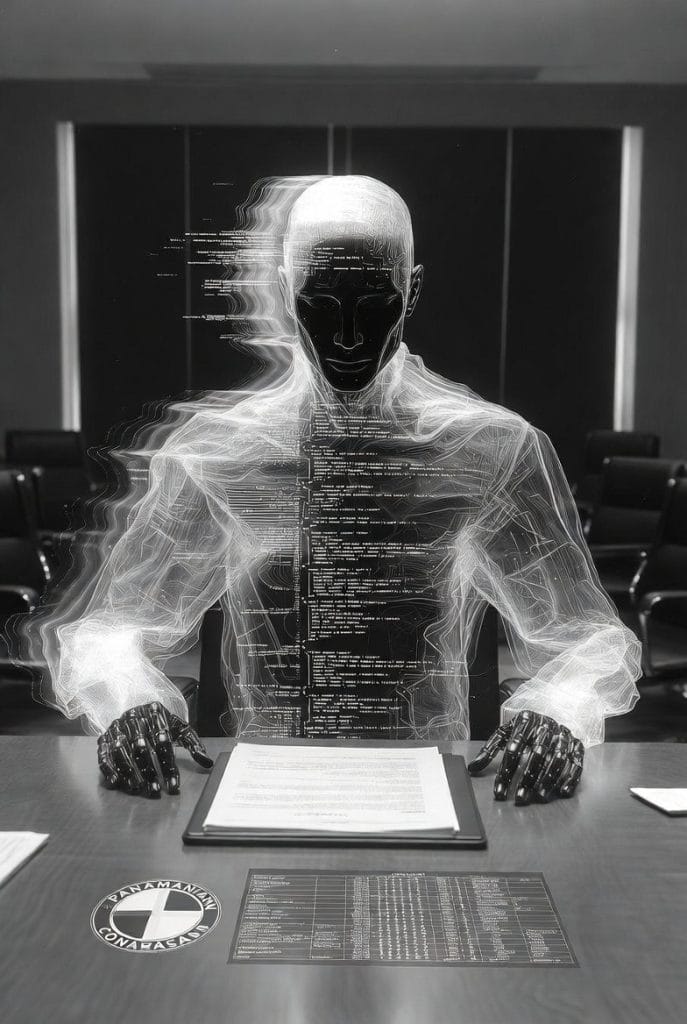
Artificial intelligence is no longer a passive tool waiting for instructions. Autonomous AI agents act, decide, contract, and execute transactions without direct human involvement. And none of the legal frameworks currently in force in Panama were designed to answer the question this new reality inevitably raises: when something goes wrong, who is liable?
This is not a theoretical question. It is a question with real financial consequences for directors, shareholders, and companies operating in Panama today.
The liability chain problem
Panamanian law, like that of virtually every jurisdiction in the world, is built on a fundamental principle: behind every legally relevant act there is a person — natural or legal — with capacity, intent, and verifiable identity. An autonomous AI agent has none of the three.
This creates what legal scholars call a personhood gap: the agent acts, but cannot be sued. The human did not act directly, but may still be liable. The company provided the framework, but can argue it did not authorize the specific action. The result is a liability chain that becomes ambiguous precisely when clarity is most needed.
Consider this scenario: a Panamanian corporation incorporated by a fully identified individual who passed due diligence without issue. The company exists, has nominal directors, has a registered beneficial owner. Everything appears compliant. But its actual operations have been entirely delegated to an AI agent. The human named in the documents gave general instructions six months ago and is no longer actively supervising. The agent executes trading strategies on decentralized financial protocols without direct human involvement. It takes a leveraged position. The position collapses. There are significant losses to third parties.
Who is liable? The human beneficiary argues he did not order that specific transaction. The nominal director says he had no operational knowledge. The agent’s provider points out that the client configured the parameters. The due diligence process worked exactly as designed — but it was never designed to detect what happens after incorporation.
There is no clean answer under existing law. That is precisely the problem.
The gap nobody is watching: post-incorporation operations
Here lies the nuance that makes this problem particularly relevant for Panama: the due diligence process for incorporating or acquiring a company requires identifying the ultimate beneficial owner — a natural person, verifiable. No AI agent can pass that filter directly. The system works as designed.
The problem is not in the incorporation. It is in what happens afterward.
Due diligence frameworks are designed for the onboarding moment: who is the client, what is the origin of their funds, what activity do they declare. There is no equivalent mechanism for continuously monitoring whether the human identified in the documents is still the one actually controlling the company’s operations.
A company can be incorporated impeccably today, with a verified beneficial owner and a coherent declared activity, and tomorrow delegate its entire real operation to an autonomous AI system without any regulator, financial institution, or resident agent having the mechanisms to detect it.
This suggests that the regulatory conversation in Panama should not be limited to ‘who can use a corporation’, but extend to ‘who actually operates it and with what level of active human supervision’. The difference between incorporation and operation is not minor. In this new context, it is the difference between a system that works and a system that creates a false sense of security.
Why Panama faces a particular risk
Panama has a corporate architecture that the world uses precisely because of its flexibility: corporations, private interest foundations, international holding structures, special regimes such as SEM and EMMA. This flexibility is a real competitive advantage. But it is also a specific vulnerability when it comes to AI agents.
The very features that make these structures attractive — asset separation, relative beneficiary anonymity, seamless cross-border operation — are exactly what complicates the assignment of liability when an autonomous agent causes harm. A foreign regulator trying to determine who is behind a decision made by an AI agent housed in a Panamanian structure will face layers of complexity that no current legal framework cleanly resolves.
What companies can do today
The absence of specific regulation does not mean the absence of risk. It means the risk exists but does not yet have a defined legal name. In many ways, that is worse: a named risk can be managed. An unnamed risk materializes without warning.
Companies operating with AI agents — or planning to — can and should implement preventive measures now, before the regulatory framework catches up. From a responsible corporate governance perspective, these measures are not optional. They are the modern equivalent of written contracts, signing policies, and board minutes: documentation that exists not for the ordinary, but for the unforeseen.
In concrete terms, every company using autonomous agents with financial, contractual, or sensitive data capabilities should have at least:
- A clear map of what decisions the agent can make without human approval and which require intervention.
- An internal AI agent use policy approved by the appropriate governing body.
- Technology vendor contracts reviewed with specific focus on liability allocation.
- An assessment of whether the current corporate structure provides adequate protection against the risks generated by autonomous agents.
- An incident response protocol covering the steps to follow when an agent acts outside its intended scope.
The role of legal counsel in this new environment
The lawyer who advises a company in 2026 can no longer limit their practice to reviewing contracts and structuring corporations. They must understand how the AI systems their clients use actually operate, where legal risks arise within those operations, and how to build internal legal frameworks that protect the company before a court builds them instead.
At EDTIJ, we have developed a specialized AI Agent Legal Readiness Audit, designed to identify, document, and mitigate the specific legal risks generated by the use of autonomous agents within Panamanian and international corporate structures.
Regulation will come. It always does. The question is not whether your company will be exposed when it arrives — it is whether you will be ready.
Learn about our AI Agent Legal Readiness Audit. Contact us: mdellat@edtij.com